

Yes. AI can be operated in a HIPAA-compliant way when specific technical and organizational controls are enforced: a signed BAA, AES-256 encryption at rest, TLS 1.3 in transit, immutable audit logs, context-aware PHI masking, and role- and context-based access controls. None of this is automatic, and no vendor can slap a “certified” badge on a product and call it done. Compliance is ongoing lifecycle work tied to frameworks like the HIPAA Security Rule and NIST’s AI Risk Management Framework, which is exactly the kind of governance-first engineering Polarising builds around.
TL;DR:
- Enforcing strict controls like signed BAAs, encryption, audit logs, and context-aware PHI masking is essential for HIPAA-compliant AI deployment, but no vendor provides automatic certification.
- PHI exists at multiple stages in AI workflows, with primary responsibilities on covered entities to manage chain-of-BAA and strictly control access and data flow.
- Vendors should be evaluated with prior documentation, technical tests, and operational simulations, emphasizing PHI detection, encryption, and incident response before production deployment.
- HIPAA, FDA, and EU AI regulations overlap but require organizations to address technical safeguards, clinical effectiveness, and cross-jurisdiction compliance simultaneously.
- Automated evidence collection and strong governance practices significantly reduce audit preparation time and help sustain compliance across evolving regulatory frameworks.
Table of Contents
- What Does “HIPAA-Compliant AI” Actually Mean?
- The Control Checklist Every HIPAA AI Pipeline Needs
- How Do You Vet an AI Vendor for HIPAA Readiness?
- Where Do HIPAA, FDA, and the EU AI Act Overlap?
- What Actually Goes Wrong: Risks and Pitfalls to Watch For
- How Polarising Builds HIPAA-Aligned AI Systems
- What I’d Tell a CIO Starting This Project Today
- Ready to Build a HIPAA-Aligned AI Pipeline?
- Sources
- FAQ
What Does “HIPAA-Compliant AI” Actually Mean?
Protected health information (PHI) is any data that ties a patient’s identity to their health status, treatment, or payment history. The moment an AI tool touches a clinical note, a patient message, a claims record, or even a de-identified dataset that could be re-linked, HIPAA’s rules apply to how that data is stored, transmitted, and processed.
Most healthcare AI deployments create PHI exposure in three places: the prompt sent to a model, the training or fine-tuning data used to build it, and the output the model generates. A clinical documentation assistant that listens to a patient encounter and drafts a note is handling PHI at every stage. A research team running a model against a properly de-identified dataset, stripped of the 18 Safe Harbor identifiers under HHS de-identification guidance, may fall outside HIPAA’s scope entirely. The difference matters enormously for how much control infrastructure you need to build.
Responsibility splits along a defined line. A covered entity (a hospital, clinic, or health plan) holds the primary HIPAA obligation. Any AI vendor touching PHI on that entity’s behalf becomes a business associate and needs a signed Business Associate Agreement, plus a documented chain of BAAs if that vendor uses subprocessors like a cloud host or a third-party model provider. Skip a link in that chain and you have a gap no amount of encryption fixes.
Here’s a phrase to retire: “HIPAA-certified AI.” HHS is explicit that no such certification exists. There’s no federal seal of approval. What organizations actually need is:
- A signed BAA covering every vendor and subprocessor touching PHI
- Documented technical safeguards mapped to the Security Rule
- Audit-ready evidence available on request during an OCR investigation
- A clear record of who accessed what data, when, and why
Anyone selling “HIPAA certification” is selling a marketing term, not a legal status.
The Control Checklist Every HIPAA AI Pipeline Needs
Before signing a contract or greenlighting an internal build, run the AI pipeline against a fixed set of technical and organizational controls. Six categories cover almost every audit finding OCR has published in the past decade.
- Encryption, both directions. Data at rest needs AES-256; data in transit needs TLS 1.3. This isn’t a suggestion buried in a compliance memo, it’s baseline expectation under HHS Security Rule guidance, and any AI vendor who can’t confirm both specifically (not “industry-standard encryption”) should be a hard no.
- Immutable audit logs. Every access event needs a record of who touched the data, what they did, when, and ideally why. Logs that can be edited or deleted after the fact are functionally useless in an OCR investigation, and enterprise teams are increasingly expected to produce per-prompt provenance in auditor-readable export formats.
- BAA and subcontractor mapping. Know every subprocessor your AI vendor uses, from the cloud host to the model API. A BAA with the primary vendor means nothing if their upstream model provider never signed one.
- PHI detection with context-preserving masking. Destructive redaction (blacking out names with no trace) can break clinical meaning a model needs to function. Context-preserving tokenization removes identifiers while keeping the surrounding clinical logic intact, which matters both for compliance and for whether the AI actually works.
- Access control built on minimum necessary. Role-based access control combined with context-based enforcement (not just “is this person a nurse” but “is this nurse treating this patient right now”) keeps exposure tight. Multi-factor authentication should gate any PHI touchpoint, full stop.
- Incident response aligned to HIPAA timelines. Breach notification rules have fixed clocks. Your AI vendor’s incident response runbook needs to plug directly into your own, with no ambiguity about who notifies whom and by when.
Organizations that automate the evidence generation behind these controls, rather than assembling it manually before every audit, report reductions in audit preparation time of at least 70%. That gap between manual and automated evidence collection is often the real difference between a compliance program that survives an audit and one that scrambles.
How Do You Vet an AI Vendor for HIPAA Readiness?
Treat vendor evaluation as a gate, not a formality. Here’s the order that actually catches problems before they become breach notifications.
Start with paperwork that predates the demo. Ask for the signed BAA template, a current SOC 2 Type II or ISO/IEC 27001 report, and evidence of an independent penetration test within the last twelve months. If a vendor hesitates on any of these, that hesitation is the answer.
Run technical acceptance tests before committing to production.
- Benchmark PHI detection recall against a representative sample of your own clinical text, not the vendor’s demo dataset
- Validate that masking preserves clinical context well enough for the model to remain useful
- Pull a per-prompt logging export and confirm it contains who, what, when, and why
- Verify encryption settings directly rather than trusting a spec sheet claim
Test operations, not just technology. Walk through the vendor’s incident response runbook line by line. Simulate a breach scenario and time how fast access gets revoked. Ask what happens if a subprocessor changes, and whether you get advance notice or find out after the fact.
Lock specific clauses into the contract, including data residency commitments, a full subprocessor list, mandatory notification before any model or provider change, and audit rights that let your team (or a designated third party) inspect controls on request.
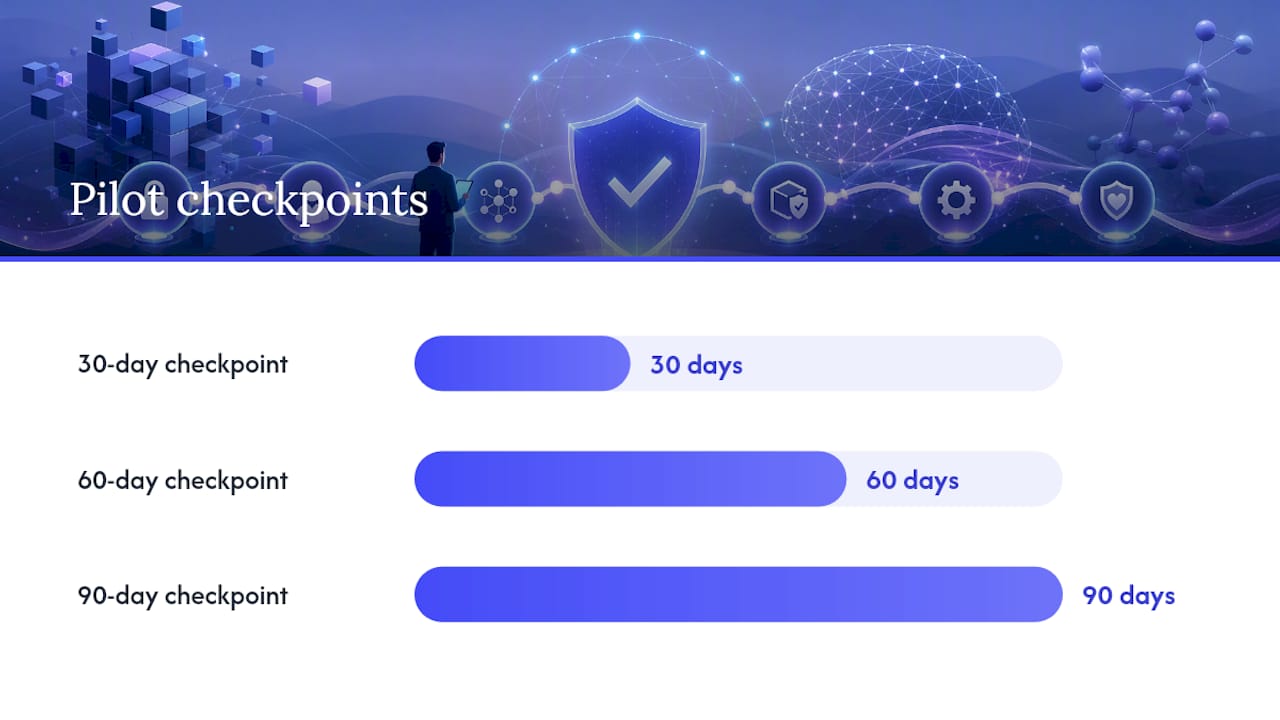
Pilot for 60 to 90 days with hard gates, not an open-ended trial. Set checkpoints at 30 days (technical controls verified), 60 days (operational runbooks tested), and 90 days (go/no-go on production rollout). Anything that fails a gate goes back to remediation, not forward to the next phase.
Pro Tip: *Run the PHI detection benchmark against your messiest real clinical notes, not clean sample text.
Where Do HIPAA, FDA, and the EU AI Act Overlap?
The HIPAA Security Rule governs how PHI is protected technically and administratively, but it doesn’t address whether an AI tool is safe or effective at its clinical task. That’s a separate question, and it’s where the FDA and international frameworks come in.
If an AI system makes or influences a diagnostic or treatment decision, it likely qualifies as Software as a Medical Device, and the FDA’s AI/ML guidance expects a lifecycle approach: predetermined change control plans, premarket review for certain risk categories, and ongoing transparency about how the model behaves after deployment. A clinical scribe that summarizes a visit note is a different regulatory animal than an AI tool that flags a probable cancer diagnosis, even though both might touch the same patient record.
For organizations operating in or selling into the EU, the Artificial Intelligence Act classifies most health-related AI as high-risk, which triggers registration, transparency obligations, and post-market monitoring requirements that apply on top of, not instead of, HIPAA. Provisions phase in through August 2026, so multinational deployments need a compliance map that satisfies both regimes simultaneously rather than treating US and EU obligations as separate projects.
A few frameworks help stitch this together operationally:
- NIST’s AI Risk Management Framework gives a structure for documenting AI-specific risks and controls that auditors increasingly expect to see referenced
- ONC’s health IT certification criteria (HT1) support evidence mapping for how AI fits into certified health IT systems
- The UK’s National Commission on AI in Healthcare recommends shared responsibility across manufacturers, providers, and clinicians with lifecycle evidence, a model worth adopting even outside the UK
For any organization running AI across multiple jurisdictions, data residency becomes its own line item. Where the model runs, where logs are stored, and where a subprocessor is headquartered all affect which regulator has standing to ask questions.
What Actually Goes Wrong: Risks and Pitfalls to Watch For
Generic data loss prevention tools were built for structured data like credit card numbers and social security numbers, not the narrative shorthand in a clinical note. Research on PHI detection confirms that generic DLP routinely misses identifiers embedded in unstructured text, which is most of what a clinician actually writes. Healthcare-specific NLP models trained on clinical language patterns catch what generic pattern-matching tools miss.
Three mistakes show up again and again. Teams trust vendor marketing language over documented evidence, accepting “enterprise-grade security” as a substitute for an actual SOC 2 report. Logging gets implemented halfway, capturing that access happened but not the context of why, which leaves gaps an OCR investigator will find immediately. And model updates roll out with no change-management process, so a vendor silently swaps the underlying model and nobody notices the PHI-handling behavior changed with it.
Agentic AI systems raise the stakes further. A model that can take autonomous action, not just generate text, needs fine-grained, context-based access enforcement and continuous monitoring, because a single bad decision compounds faster than a human reviewer can catch it. Staged rollouts, continuous compliance monitoring, and enforced minimum privileges are the practical antidote, applied consistently rather than as a one-time launch checklist.

How Polarising Builds HIPAA-Aligned AI Systems
Polarising approaches HIPAA-aligned AI as an engineering problem with governance built in from day one, not bolted on after a pilot’s success. That shows up across a few specific service lines:
- AI Engineering work maps directly to the control checklist above: encryption, access controls, and audit logging designed into the pipeline rather than retrofitted
- AI Pods draw on experience delivering work inside regulated environments regularly, rather than treating healthcare as a one-off vertical
- AI-assisted legacy system analysis helps organizations understand where PHI already flows through existing systems before adding a new AI layer on top
What I’d Tell a CIO Starting This Project Today
The teams that get HIPAA-aligned AI right treat it as shared, ongoing responsibility between the covered entity, the vendor, and every subprocessor in between, not a checkbox their legal department signs off on once. That framing matches where regulators are heading: lifecycle evidence over point-in-time certification.
If you’re at the start of this, don’t spend three months writing a policy document. Run a focused 60 to 90 day pilot with per-prompt logging turned on from day one and a PHI-detection benchmark run against your own clinical text. Negotiate the BAA and subprocessor chain before the pilot starts, not after it succeeds. The organizations that stall are almost always the ones that treated the paperwork as a formality to handle later.
— Polarising Team Leader
Ready to Build a HIPAA-Aligned AI Pipeline?
If you’ve made it this far, you already know the gap between “our AI vendor says they’re compliant” and having audit-ready evidence sitting in a folder is where most healthcare organizations get burned. Polarising works as a direct engineering partner on exactly this problem: mapping AI engineering work to the specific controls covered above, from BAA chains to immutable audit logs to context-preserving PHI masking, delivered by senior nearshore teams who’ve built inside regulated environments before, not learned on your production data.

For organizations further along, enterprise integration work covers the harder problem of connecting a new AI layer to legacy clinical systems without introducing new PHI exposure points in the process. Either way, the next step is a technical assessment, not a sales call. Visit Polarising’s solutions page to scope a pilot against your own compliance requirements before your next audit cycle starts.
This article is general information, not a substitute for advice from a qualified doctor. Consult a qualified healthcare professional about your own circumstances before acting on anything here.
Sources
- HIPAA Security Rule | HHS
- National Commission into the Regulation of AI in Healthcare: Recommendations for a future regulatory framework
- Artificial intelligence (AI) and machine learning (ML) for medical devices | FDA
- PMC article on PHI detection limits of generic DLP
- Regulation (EU) 2024/1689 (Artificial Intelligence Act) | EUR-Lex
FAQ
Does ChatGPT Have a HIPAA-Compliant Version?
OpenAI offers enterprise agreements that can include a signed BAA for certain API and business products, but a standard consumer ChatGPT account is not covered by a BAA and should never be used with PHI. Confirm the exact product tier and BAA scope directly with OpenAI before any clinical use.
Is AI Prohibited by HIPAA?
No. HIPAA doesn’t ban AI; it requires that any system touching PHI, AI included, meet the same technical and administrative safeguards as any other health IT system, backed by a BAA and documented controls.
What Is the 30% Rule in AI?
If you’ve seen this referenced elsewhere, it’s likely a misattributed or informal figure rather than a standard, and it shouldn’t guide a compliance decision.
Does OpenAI Have a HIPAA-Compliant Version?
OpenAI provides a BAA for qualifying enterprise and API customers under specific terms, but this depends on the product and contract tier rather than being a blanket feature of every OpenAI offering. Verify BAA coverage and data handling terms for your specific use case before processing any PHI.