

An AI readiness assessment is a scored diagnostic across core organizational pillars that produces a prioritized roadmap leaders can act on immediately. It measures strategy, data, infrastructure, governance, talent, and culture, then converts the gaps into a sequenced plan. Frameworks from Gartner, the ITU, and companies like Polarising all converge on this basic structure: score it, diagnose it, fix it in order.
TL;DR:
- A comprehensive AI readiness assessment identifies gaps in strategy, data, infrastructure, governance, talent, and culture, guiding targeted improvements.
- Benchmarking maturity involves scoring organizations on defined levels, with granular frameworks like the ITU providing sector-specific comparisons.
- Effective assessments require multi-stakeholder teams, evidence gathering, and a 4 to 8-week process that combines interviews, data review, and technical sampling.
- Scores usually appear as heat maps highlighting uneven maturity, with organizations advised to prioritize foundational pillars like culture and governance first.
- External partners are most beneficial for legacy-heavy or regulated sectors, helping detect integration risks and ensuring implementation capacity.
Table of Contents
- What Does an AI Readiness Assessment Measure?
- How Do Maturity Frameworks Turn This Into a Score?
- How Do You Run an AI Readiness Assessment?
- How Do You Read the Scores Once You Have Them?
- Turning Gaps Into a 90-Day, 6-Month, and 12-Month Plan
- When Should a Leader Bring in an External Assessment Partner?
- Ready to Move From Diagnosis to Delivery?
- Frameworks Worth Consulting Directly
- Sources
- FAQ
What Does an AI Readiness Assessment Measure?
Every credible model breaks the organization into a handful of pillars, and Cisco’s framework lists six that show up almost everywhere else too:
- Strategy: does leadership have a defined business case for AI, or is it a collection of disconnected pilots?
- Data: is data accessible, governed, and clean enough to train or feed a model reliably?
- Infrastructure and technology: can existing systems support deployment, or does legacy architecture bottleneck everything?
- Governance and ethics: are there controls for risk, bias, and accountability before something goes live?
- Talent and skills: does the organization have people who can build, evaluate, and maintain AI systems?
- Culture and adoption: will staff actually use the tools, or will they route around them?
A weak data pillar quietly kills more AI projects than a weak model ever does. An organisation can hire brilliant data scientists and still stall for a year because nobody can locate a clean, labeled dataset. Governance works the same way in reverse: skip it early, and you inherit a compliance crisis right as the pilot gets attention from the board.
How Do Maturity Frameworks Turn This Into a Score?
Several established models exist, and picking one (or blending two) beats inventing your own from scratch. Gartner’s maturity model frames readiness as a planning tool for moving pilots into measurable return on investment. The MITRE AI Maturity Model and comparable work from Forrester and the Software Engineering Institute take a similar evidence-based approach, scoring organizations against defined levels rather than a vague gut check.
The ITU AI Readiness framework goes further on structure: it defines six fundamental factors and maps 13 distinct dimensions, each with its own index for self-assessment and peer benchmarking. That granularity matters when you want to compare your organization against sector peers rather than an abstract ideal.
Typical output: PwC’s assessment model produces a 0 to 100 readiness score alongside a domain-by-domain gap diagnosis, prioritized recommendations, and roadmaps built around 90, 180, and 365-day horizons. That kind of tiered output is what turns a survey into something a board can actually act on.
A few things to check when comparing frameworks:
- Does it produce a numeric score, a maturity stage, or both?
- Can you benchmark against peers in your sector, or only against yourself over time?
- Does it separate technical maturity from organizational maturity?
Not every organization needs to chase the top tier. AI Singapore’s guidance suggests most enterprises should target a mid-level “AI Ready” stage rather than the highest maturity band, since chasing the ceiling often means diminishing returns for the investment.
How Do You Run an AI Readiness Assessment?
Running the assessment well matters more than which framework label you put on it. Here’s a compact process that works for most mid-size to large organizations:
- Assemble a cross-functional team. Include IT, data, legal/compliance, HR, and at least one business unit leader, not just the CIO’s office. UNESCO’s Readiness Assessment Methodology specifically warns against technical-only audits that skip business stakeholders, since that’s how you end up with a report nobody upstream trusts.
- Gather the evidence. Pull data inventories, existing model logs, policy documents, and results from any pilots already running. Don’t rely on what people say is happening; check what the logs say is happening.
- Run a mixed-method diagnostic. Combine leadership interviews, staff surveys, and a technical sample, such as auditing one end-to-end pilot to check whether the scorecard’s assumptions hold up in practice.
- Set a 4 to 8 week timeline for the core diagnostic. Longer than that and momentum dies; shorter, and you risk a shallow, checklist-only pass.
- Score and document. Use a scorecard with clear KPIs per pillar so results are traceable back to specific evidence, not vibes.
Pro Tip: Never let one department run the assessment alone. A CIO-only diagnostic almost always overweights infrastructure and underweights culture, while an HR-led one does the opposite. Evidence-based, multi-stakeholder input consistently produces more reliable, actionable readiness scores than a single perspective ever will.
How Do You Read the Scores Once You Have Them?
Most scorecards render as a heat map: one axis for pillars, one for business units, colored by maturity band. It’s a useful visual because it shows unevenness fast, a strong data score sitting right next to a governance score in the red.
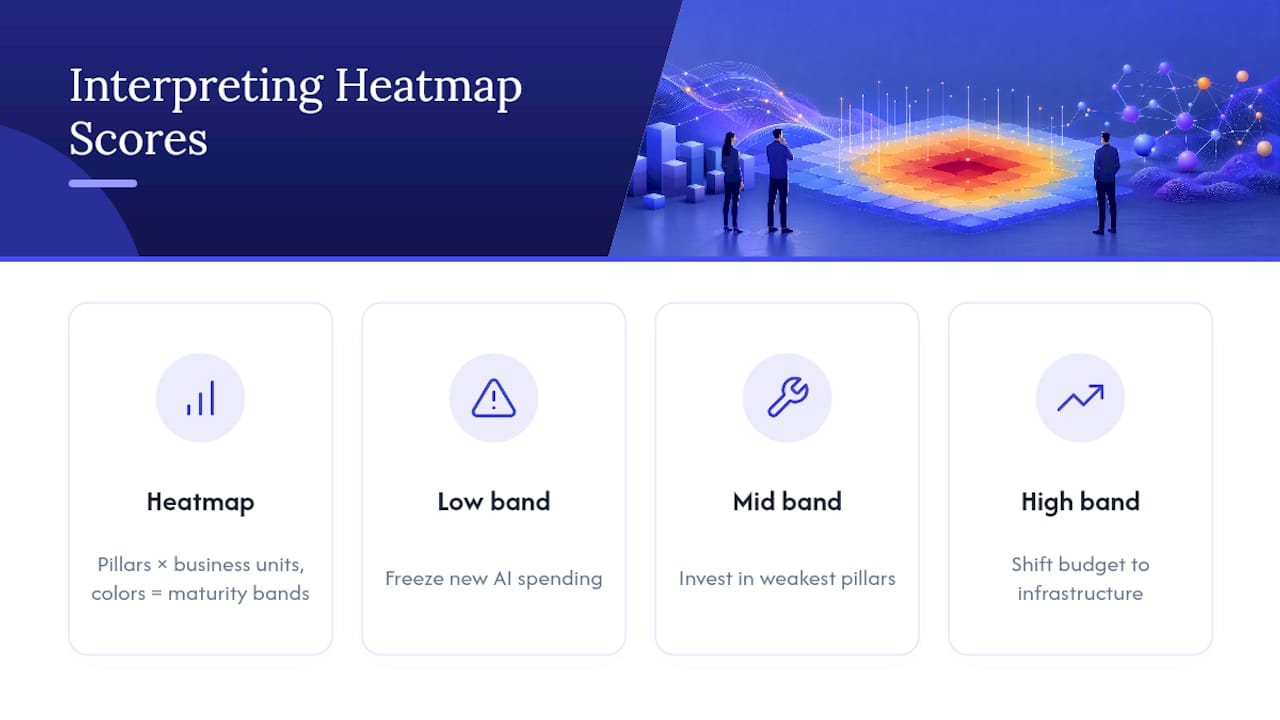
Typical maturity bands run roughly like this: a low band signals disconnected pilots and no governance, meaning you should freeze new AI spending until basics are fixed. A middle band means foundational pieces exist but aren’t integrated, meaning targeted investment in the weakest one or two pillars. A high band means the organization can scale AI with existing controls, meaning it’s time to shift budget toward larger infrastructure bets.
Watch for two common misreads. First, overconfidence: a strong strategy score doesn’t offset a weak data pillar, it just means leadership has good intentions with no foundation to execute them. Second, sample bias: a scorecard built entirely on interviews with senior leadership will almost always score higher than one that includes frontline staff and technical sampling, because leadership tends to overestimate how ready the ground floor actually is.
Tie every score to a measurable KPI, whether that’s model deployment lead time, data access latency, or percentage of staff completing required AI governance training, so progress in six months is provable, not just claimed.
Turning Gaps Into a 90-Day, 6-Month, and 12-Month Plan
Once you have the scorecard, prioritize fixes with a simple impact times effort lens: which gaps unlock the most value for the least lift. A recommended sequence, drawn from how organizations like AI Singapore frame remediation, runs leadership and culture first, governance and ethics second, quick business-value pilots third, then data foundation and infrastructure last. That order might feel backward to engineers who want to fix data first, but culture and governance gaps sink pilots faster than technical debt does.
A sample milestone structure:
- 90 days: leadership alignment workshop completed, governance policy drafted, one low-risk pilot identified with clear success metrics.
- 6 months: governance policy formally adopted, first pilot in production with measured business impact, data inventory gaps documented for the two highest-priority use cases.
- 12 months: infrastructure investment approved for scaling, second and third use cases in pilot, staff training program measurably improving adoption scores.
Success signals at each stage should be numeric, not aspirational. Deployment counts, adoption percentages, and cycle-time reductions all beat a vague “on track” in a steering committee slide.
When Should a Leader Bring in an External Assessment Partner?
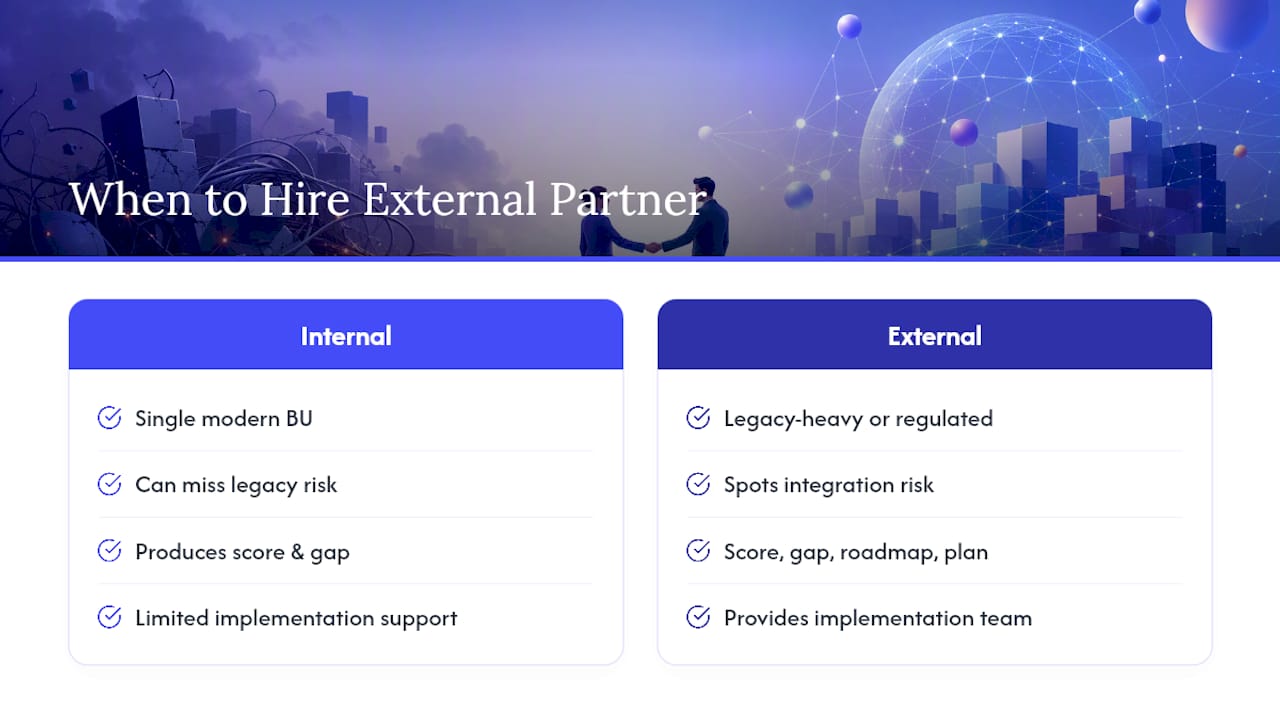
Internal teams can run a solid first-pass assessment, especially for a single business unit with modern systems. Where it gets harder is legacy-heavy environments, regulated data (finance, healthcare, telecom), or anything touching agentic or multi-agent systems, where the governance and integration risk compounds fast and an internal team often lacks the pattern recognition to spot it.
Some firms approach this as an engineering and integration problem as much as a data problem, leveraging extensive experience in regulated sectors. A typical external engagement produces the same core deliverables an internal team would want: a scored diagnostic, a domain-by-domain gap analysis, a prioritized roadmap, and, where needed, an implementation plan or augmented delivery team to execute it. The value of bringing in outside eyes usually isn’t the scorecard itself. It’s catching the legacy integration risk that a purely internal review, close to the systems and the politics around them, tends to miss.
— Polarising Blog
Ready to Move From Diagnosis to Delivery?
Outsourcing an AI readiness assessment can help avoid common pitfalls where the real bottleneck is legacy system integration rather than the AI model itself. A typical engagement pairs a scored diagnostic with a prioritized roadmap and, when the gaps demand it, a senior nearshore team to actually close them rather than hand you a slide deck and walk away.
That combination matters because assessments without delivery capacity tend to gather dust. Polarising’s AI engineering work is built specifically for legacy-heavy, regulated estates in finance, healthcare, telecom, and retail, where governance and accountability must be designed in from day one, not bolted on after a pilot fails an audit. If your last assessment produced a report and nothing else, the next step is a conversation about what the Polarising solutions page actually covers, and whether a scoped engagement or a team augmentation model fits your timeline better.
Frameworks Worth Consulting Directly
- Gartner’s AI maturity model toolkit for planning and prioritization language boards already recognize.
- The ITU AI Readiness report for granular, benchmarkable dimensions.
- SEI/CMU’s AI Adoption Maturity Model for evidence-based scoring methodology.
- OWASP’s AI Maturity Assessment for security and ethical risk checks most business-only frameworks skip.
Sources
FAQ
What Is a Readiness Assessment for AI?
It’s a structured diagnostic that scores an organization across pillars like strategy, data, infrastructure, governance, talent, and culture, then produces a prioritized action plan based on where the biggest gaps sit.
How Do You Measure AI Readiness?
Most frameworks combine surveys, leadership interviews, and technical sampling, such as auditing model logs or a live pilot, then map the findings against a maturity scale like the ones from Gartner or the ITU.
How Do You Evaluate AI Readiness Across Departments?
Evaluate each business unit separately against the same core pillars, since maturity often varies sharply between departments, and a single company-wide score can hide a unit that’s dangerously behind.
What Is an “AI Ready” Test, and What Score Counts as Good?
There’s no universal passing score. Scorecards like PwC’s run 0 to 100, and most organizations should target a solid mid-tier maturity level rather than the top band, since the highest tier often costs more than the additional readiness is worth.
When Does It Make Sense to Bring in an External Partner Like Polarising?
External help tends to pay off most in legacy-heavy or regulated environments, finance, healthcare, telecom, where integration risk and governance complexity exceed what an internal audit typically catches.