

Yes, enterprise AI can deliver measurable value, but only when governance, data readiness, and operating model changes are in place before scale-up begins. The single biggest predictor of return isn’t the model you pick. It’s organizational readiness, meaning who owns the outcome, how clean the data is, and whether anyone has the authority to kill a bad pilot. If you take one action this quarter, audit your governance structure before you fund another use case.
TL;DR:
- Organizational ownership, data quality, and clear escalation paths are critical to scaling enterprise AI beyond pilots, regardless of the model used.
- Most enterprises have high pilot volume but limited production deployment and little measurable EBIT impact, with gains appearing mainly in speed and satisfaction.
- Effective governance, including detailed AI inventories, audit trails, and risk management, accelerates safe deployment and regulatory compliance.
- Success depends on combining rigorous data infrastructure, tailored platform choices, dedicated operational roles, and a structured 12–24 month adoption roadmap.
- Building trust, managing change, and stakeholder communication are vital, as resistance often stems from job uncertainty rather than technology complexity.
Table of Contents
- What Is the Current State of Enterprise AI Adoption?
- Why Do So Many AI Initiatives Fail to Scale?
- How Should Executives Measure Enterprise AI ROI?
- Is Your Data and Platform Infrastructure Ready for AI?
- What Skills and Roles Does Enterprise AI Require?
- How Do You Build a 12–24 Month Enterprise AI Adoption Roadmap?
- Where Is Enterprise AI Delivering the Most Value?
- What Does It Take to Keep AI Reliable in Production?
- What Regulatory and Compliance Issues Should Executives Track?
- How Do You Manage Change and Cultural Resistance to AI?
- How Should You Engage Stakeholders Across the Organization?
- What Security and Privacy Risks Are Unique to Enterprise AI?
- How Should You Evaluate AI Vendors and Technology Partners?
- How Do You Handle AI Ethics Beyond Governance Checklists?
- Polarising Perspective: What Large-Scale Integration Projects Actually Teach
- How Polarising Helps Execute Your Enterprise AI Roadmap
- Sources
- FAQ
What Is the Current State of Enterprise AI Adoption?
Most large organisations have moved past the “should we try AI” question and landed somewhere more uncomfortable: dozens of pilots, a handful of production deployments, and not much financial proof to show the board. McKinsey’s global survey work finds that most organizations are still experimenting rather than scaling, and only a minority can attribute a measurable EBIT impact directly to their AI investments. That gap between activity and outcome is the defining feature of enterprise AI adoption right now.
Deloitte’s research tells a similar story from a different angle. Productivity gains and improved customer satisfaction show up broadly across surveyed firms, but genuine process reinvention, the kind that moves a P&L line, remains rare. Leaders report AI making individual workflows faster. Fewer report AI changing how the business actually operates.
Sector performance varies sharply. Deloitte’s sector data points to manufacturing, logistics, and defense as leaders in physical and agentic AI, where autonomous systems handle scheduling, routing, and quality inspection with less human oversight. Finance and healthcare move more cautiously, weighted down by regulatory exposure and a justified obsession with auditability.
A few patterns show up consistently across the survey data:
- Pilot volume is high; production deployment volume is a fraction of that.
- EBIT-level impact is reported by a minority of organizations, concentrated in firms with mature governance.
- Agentic AI adoption is accelerating fastest in operations-heavy sectors with structured, rules-based workflows.
- Qualitative benefits (speed, satisfaction, innovation perception) arrive well before financial benefits do.
None of this means enterprise AI strategy is failing. It means most companies are still building the scaffolding, and the ones who built it first are the ones already collecting value.
Why Do So Many AI Initiatives Fail to Scale?
The failures rarely trace back to the model. They trace back to the org chart. Case-based research from Stanford’s digital economy lab found that identical use cases, running on identical technology, produced wildly different outcomes depending on organizational readiness alone. Same tool, same data type, different governance, different result.
Three failure patterns show up over and over:
- The perpetual pilot. A use case proves itself in a controlled sandbox and then never leaves it, because nobody owns the decision to fund production infrastructure.
- Fragmented ownership. Marketing runs one AI initiative, operations runs another, IT runs a third, and none of them talk. Budgets fragment along the same lines, so no single project ever gets enough funding to reach production maturity.
- Workflow disconnects. The AI output exists outside the tool people actually use every day, so employees either ignore it or manually re-enter it somewhere else, quietly killing the productivity gain the pilot was built to prove.
Underneath all three sits the same root cause: no escalation path. When a pilot stalls, there’s no committee, no executive sponsor, and no defined process to either fund it properly or shut it down. It just sits there consuming budget and credibility.
Pro Tip: Before greenlighting a new pilot, write down who has the authority to kill it. If you can’t name that person in one sentence, you’ve already found your governance gap.
The fix isn’t more pilots. It’s fewer pilots with clearer ownership, tighter budget lines, and a defined path to either scale or sunset. Enterprises that build this structure first tend to convert a higher share of their pilots into production systems, simply because someone is accountable for the decision either way.

How Should Executives Measure Enterprise AI ROI?
Measuring the ROI of generative AI at the enterprise level requires more than a satisfaction survey. It requires baseline metrics captured before the AI touches the process, and a defined attribution method so you can tell the difference between AI-driven improvement and improvement that would have happened anyway.
Start with a short list of KPIs that map to money, not sentiment:
- EBIT lift attributable to the specific process the AI touches, not company-wide performance.
- Process cycle time, measured before and after, on the same workflow segment.
- Error or rework rate, especially in high-volume back-office and customer-facing processes.
- Cost-to-serve, particularly for support, claims processing, and fulfillment functions.
Attribution works best when you isolate a control group, or at minimum a “before” baseline captured over a comparable time window (same season, same volume level). Skipping the baseline is the most common measurement mistake executives make. Without one, every improvement gets credited to the AI project regardless of cause.
For gating, apply a simple launch, continue, or drop rule at fixed checkpoints, typically 90 days after pilot start and again at the six-month mark:
- Launch to production if the KPI shows a clear, attributable improvement and the workflow integration is stable.
- Continue in pilot if results are promising but attribution is unclear or adoption is uneven.
- Drop if the KPI shows no movement after two full measurement cycles, or if the workflow disconnect problem described earlier hasn’t been solved.
Deloitte’s enterprise research confirms this pattern directly: firms reporting real EBIT impact overwhelmingly built structured measurement into the project from day one, rather than retrofitting it after the fact. Measurement isn’t a report you generate at the end. It’s infrastructure you build at the start.
What Does the NIST AI RMF Mean for Enterprise Governance?
The NIST AI Risk Management Framework organizes trustworthy AI practice into four functions: GOVERN, MAP, MEASURE, and MANAGE. That structure translates cleanly into enterprise practice, and it gives procurement and legal teams a shared vocabulary instead of ad hoc risk debates on every project.
GOVERN sets the policy layer: who approves a new AI use case, what documentation is required, and how accountability flows up to the executive team. MAP identifies context and risk for each specific use case, since a customer chatbot and a credit-decisioning model carry very different risk profiles even on the same platform. MEASURE defines the metrics and testing needed to know whether the system behaves as intended, including bias and drift testing. MANAGE covers the ongoing response: incident handling, retraining triggers, and the authority to pause a system that’s misbehaving in production.
Enterprises that treat governance as a speed enabler, not a compliance tax, consistently reduce rework and get systems into production faster, because fewer projects get stalled or unwound after the fact for missing basic documentation.
In practice, this means building an AI inventory: a living register of every model in production, who owns it, what data feeds it, and when it was last validated. Audit trails need to be built into the deployment pipeline itself, not bolted on afterward as a compliance report nobody reads until there’s a problem.
For procurement, a governance-first checklist should ask vendors direct questions:
- Can the vendor document the training data sources and any known limitations?
- What explainability tooling exists for this specific model type?
- How does the vendor handle model updates, and will your organization be notified before behavior changes?
- What data residency and retention terms apply, and do they match your regulatory obligations?
- Does the vendor support integration with your existing audit and logging infrastructure?
Governance done well, is what the OpenAI enterprise guide points to as the real differentiator once base models become largely interchangeable across vendors.
Is Your Data and Platform Infrastructure Ready for AI?
Most AI projects don’t fail because the model underperforms. They fail because the data feeding it is scattered across systems that don’t agree with each other. A single source of truth for the data a given use case depends on isn’t optional infrastructure. It’s the precondition for any of the KPI measurement described earlier to mean anything.
Platform choice matters almost as much as data quality, and it’s not a one-size answer. Microsoft’s Cloud Adoption Framework maps four practical models, each trading speed against control:
- Ready-to-use Copilots for fast deployment on standard productivity tasks, with minimal customization.
- Low-code SaaS AI tools for business teams that need speed without a full engineering build.
- Managed PaaS platforms for teams that need customization and integration depth without owning infrastructure.
- Owned infrastructure for organizations with strict data residency, latency, or compliance requirements that off-the-shelf platforms can’t meet.
The right choice depends on the use case, not on organizational preference. A customer-facing chatbot in a low-risk retail context has very different platform needs than a fraud-detection model running against live transaction data in a regulated bank.
Once a system is in production, monitoring becomes the ongoing cost of staying reliable. Retrieval-augmented generation systems in particular tend to lose retrieval accuracy over time without active monitoring, as underlying document sets shift and go stale. Drift detection, retrieval accuracy tracking, and business-metric correlation all need to run continuously, not as a quarterly checkup.
Pro Tip: Treat your data pipeline like production infrastructure, with the same uptime and monitoring standards as your core transaction systems. If a pipeline outage would go unnoticed for a week, you don’t have a data platform. You have a science project.
Integration work is often the least glamorous and most decisive part of the build. A firm like Ampwise, which focuses on merging email and ERP data streams, illustrates the kind of workflow integration enterprises frequently underestimate. The model is rarely the hard part. Getting it fed clean, current data from systems that were never designed to talk to each other is.
What Skills and Roles Does Enterprise AI Require?
Scaling AI changes who you hire and how you organize, not just what tools you buy. A handful of roles show up repeatedly in organizations that move past the pilot stage successfully:
- AI operations leads who own production reliability, similar to a site reliability engineer but focused on model behavior and drift.
- Data stewards responsible for the quality, lineage, and access controls on the data feeding each production model.
- Human-AI interaction specialists who redesign workflows so employees actually trust and use the AI output rather than working around it.
- Governance and risk liaisons who translate NIST RMF style requirements into day-to-day approval processes.
Most enterprises get the hiring-versus-upskilling balance wrong in one direction or the other. Hiring a wave of specialized AI talent without upskilling the existing workforce creates a two-tier organization where AI knowledge sits in a silo. Upskilling everyone without any dedicated specialists leaves nobody accountable for the harder governance and reliability questions. The better path blends both: a small dedicated team paired with structured upskilling for the roles closest to the affected workflows.
Job redesign matters more than most roadmaps acknowledge. When AI takes over a task, the human role usually shifts toward review, exception handling, and judgment calls, not disappearance. Career paths need to reflect that shift explicitly, or you’ll lose good people who assume the AI is coming for their job rather than reshaping it.
On the operating model question, centralized structures give you consistent governance but slower use-case delivery. Federated structures move faster on individual use cases but risk the silo problem described earlier. Most large enterprises land on a hybrid: a central governance function, following an approach similar to what’s outlined in Polarising’s own governance practices, paired with federated delivery teams close to the business problem.
How Do You Build a 12–24 Month Enterprise AI Adoption Roadmap?
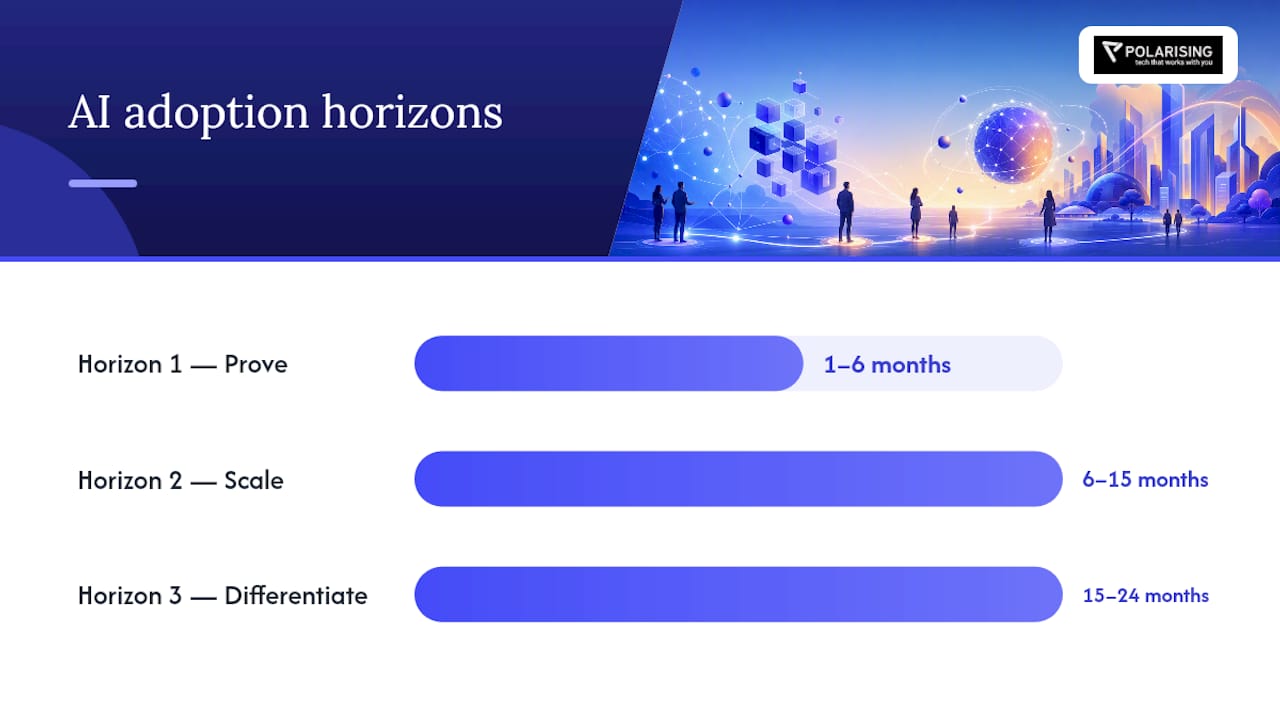
A workable enterprise AI strategy sequences work into three horizons instead of trying to do everything at once. Practitioner guidance on AI adoption roadmaps consistently recommends this horizon structure, and skipping the early foundation work is the single most common reason second-phase projects stall.
Horizon 1 (months 1 to 6): Prove. This phase builds the foundation everything else depends on:
- Establish an AI governance body with real decision authority, not an advisory committee that meets quarterly and approves nothing.
- Build the AI inventory and audit trail infrastructure described earlier, before you have dozens of models to retroactively document.
- Fix data quality and ownership issues in the two or three domains your highest-priority use cases depend on.
- Select a platform model (Copilot, SaaS, PaaS, or owned infrastructure) matched to your top use case’s risk profile.
- Launch two or three tightly scoped pilots with clear, pre-agreed KPIs and a hard 90-day review date.
Horizon 2 (months 6 to 15): Scale. Move the pilots that cleared their gates into production, and build the operational muscle to support more than a handful of live systems simultaneously. This is where MLOps discipline, incident response playbooks, and retraining cadences need to exist, not get improvised.
Horizon 3 (months 15 to 24): Differentiate. With foundations and scaling discipline in place, this phase targets agentic workflows and process reinvention rather than point-solution efficiency gains, the kind of work Deloitte’s research associates with the minority of firms reporting real EBIT impact.
Gate criteria should stay consistent across horizons even as the use cases change:
- Does the pilot show attributable KPI movement against a real baseline?
- Is governance documentation complete and current for this system?
- Is the workflow integration solving the disconnect problem, or creating a new manual step?
- Does the business owner have budget and authority to fund the next phase?
Every gate failure should have a default action: fix, pause, or kill. A pilot with no default action is exactly how the perpetual pilot problem starts.
Where Is Enterprise AI Delivering the Most Value?
Certain use-case categories show up repeatedly among enterprises reporting real value, not just activity:
- Customer support agents that resolve routine tickets and escalate complex cases with full context intact.
- Knowledge management systems that surface institutional knowledge buried in documents, tickets, and chat history.
- Supply chain optimization for demand forecasting and routing, especially in manufacturing and logistics.
- Fraud detection and anomaly monitoring in finance, where pattern recognition at scale outperforms manual review.
- Autonomous workflow agents that chain multiple steps together, increasingly common in operations-heavy sectors.
Manufacturing and logistics lead in physical and agentic AI because their workflows are structured and rules-based, which makes automation both easier to build and easier to validate. Finance follows closely in fraud and risk use cases, where the payoff on catching bad transactions early is immediate and quantifiable. Healthcare moves more cautiously, appropriately so, given the stakes of an error in a clinical or billing context, but administrative use cases like prior authorization and documentation are proving out faster than clinical decision support.
Success criteria differ by category. A support agent succeeds on resolution rate and customer satisfaction. A fraud model succeeds on catch rate versus false positive rate. An autonomous workflow agent succeeds on end-to-end completion rate without human intervention. Picking the wrong success metric for the use-case category is a quieter but common way ROI conversations go sideways.
What Does It Take to Keep AI Reliable in Production?
Getting a model into production is the easy part compared to keeping it reliable six months later.
Core practices that separate reliable production AI from fragile pilots:
- Automated monitoring for data drift, so a shift in input patterns gets flagged before it degrades output quality.
- Retrieval accuracy tracking for any RAG-based system, since retrieval quality degrades as underlying documents age without active refresh cycles.
- Direct correlation tracking between model behavior and the business metric it’s supposed to move, not just technical accuracy scores.
- A defined incident playbook specifying who gets paged when a model starts behaving unexpectedly, and what the rollback procedure looks like.
- A retraining cadence tied to observed drift, not an arbitrary calendar schedule that might retrain too often or not often enough.
Governance handoffs matter here too. When a model gets retrained or updated, that change needs to flow back through the same governance and audit trail infrastructure established in Horizon 1, not bypass it because the update felt minor. Embedding explainability checks and audit logging directly into the deployment pipeline, rather than generating them as after-the-fact reports, cuts down on audit friction significantly and lets teams catch problems while they’re still cheap to fix.
What Regulatory and Compliance Issues Should Executives Track?
Regulation around enterprise AI is moving fast enough that a static compliance checklist goes stale within a year. The practical response isn’t to chase every new rule as it appears, but to build a compliance function flexible enough to absorb new requirements without rebuilding your governance structure from scratch each time.
Data residency and privacy rules vary sharply by jurisdiction and by sector, and a system trained or hosted in one region may face different obligations depending on where your customers or employees are located. Financial services and healthcare carry additional sector-specific obligations around model explainability and audit access, often requiring that a human be able to explain any automated decision that affects a customer materially.
Rather than treat compliance as a separate track from the governance work covered earlier, fold it into the same AI inventory and audit trail infrastructure. A system that’s already documented for GOVERN and MAP purposes is most of the way toward whatever a new regulatory requirement will ask for anyway. The organizations caught flat-footed by new AI regulation are almost always the ones that never built the documentation habit in the first place, not the ones facing a genuinely novel legal question.
Legal and compliance teams should have a standing seat on the AI governance body described in the roadmap section, not a review role that happens after a system is already built. Retrofitting compliance onto a live production system is far more expensive and disruptive than building it in from the first pilot.
How Do You Manage Change and Cultural Resistance to AI?
Technology adoption curves are well understood. AI adoption inside a large organization tends to break that pattern, because the resistance isn’t about learning a new tool. It’s about uncertainty over what the tool means for someone’s job.
Ignoring that uncertainty is the fastest way to sabotage an otherwise well-built pilot. Employees who fear displacement will quietly work around a new system rather than adopt it, which produces exactly the workflow disconnect described earlier in the failure patterns. The fix starts with transparency about what the AI is actually meant to do: automate a task, augment a task, or eliminate a task. Vague messaging breeds worse assumptions than honest ones.
Change management works best when it’s built into the pilot itself, not scheduled as a training session after the system launches. That means involving the actual employees who’ll use the tool during the pilot design phase, so their workflow knowledge shapes the system instead of getting bolted on as an afterthought. It also means giving managers concrete language for how a role changes, tied to the job redesign work covered in the operating model section, rather than leaving them to improvise reassurance.
Momentum matters as much as messaging. A visible early win, even a modest one, does more to shift culture than a well-produced internal memo about the AI strategy. Pick your first pilot partly for its change management value, not just its ROI potential. An easy, visible success in a well-liked team spreads adoption faster than a technically impressive win buried in a back-office function nobody sees.
How Should You Engage Stakeholders Across the Organisation?
Enterprise AI touches nearly every function eventually, which means a communication plan built for one department will leave the rest of the organisation guessing. Executives, legal, IT, and frontline teams all need something different from an AI update, and treating them identically is a common early misstep.
Executives need outcome-level reporting tied to the KPIs established earlier: cost impact, cycle time, error rate, framed against the baseline. Board-level updates should focus on risk posture and value trajectory, not technical architecture. Legal and compliance need visibility into the AI inventory and audit trail as it grows, with a standing channel to flag concerns before a system reaches production rather than after.
Frontline employees need something closer to plain language: what the system does, what it doesn’t do, and what happens to their role. Skipping this group in favor of executive updates is one of the most common stakeholder engagement failures, because the people closest to the workflow are also the ones most able to quietly undermine a badly explained rollout.
A practical cadence works better than a one-time launch announcement. Monthly governance body updates, quarterly executive reviews tied to the gate criteria from the roadmap, and rolling frontline communication tied to each pilot’s actual milestones keep the message current instead of stale. Silence between updates tends to get filled with speculation, and speculation about AI and jobs rarely lands in the organization’s favor.
What Security and Privacy Risks Are Unique to Enterprise AI?
Enterprise AI systems introduce risk categories that traditional application security programs weren’t built to catch. A model trained on internal data can leak fragments of that data through its outputs if not carefully controlled, a risk that doesn’t exist in a standard web application.
Prompt injection is a newer and less understood risk category, where a malicious input manipulates a model into ignoring its instructions or exposing information it shouldn’t. Any customer-facing AI system needs testing specifically against this class of attack, not just standard penetration testing built for traditional software.
Data used to train or fine-tune a model carries its own exposure risk. If sensitive customer or employee data feeds a model, that data’s sensitivity effectively travels with the model wherever it’s deployed, including third-party platforms if you’re using a managed service. Vendor contracts need explicit language covering how training data is used, retained, and isolated from other customers on a shared platform.
Access control for AI systems needs the same rigor as access control for any system touching sensitive data, but it’s frequently overlooked because a chatbot interface feels less sensitive than a database console. If the model has access to sensitive records, the access control needs to match, regardless of how casual the interface feels.
Building these checks into the audit trail and governance infrastructure covered earlier means security review isn’t a separate gate bolted onto the process. It’s part of the same MAP and MANAGE functions from the NIST framework, applied specifically to the risks that make AI systems different from traditional software.
How Should You Evaluate AI Vendors and Technology Partners?
Choosing a vendor for enterprise AI work carries higher stakes than a typical software purchase, because the vendor’s practices around data handling, model updates, and support directly affect your governance posture, not just your feature set.
Start evaluation with the questions raised earlier in the procurement checklist: training data transparency, explainability tooling, update notification practices, and data residency terms. Beyond that baseline, weigh a few practical factors that separate a vendor who fits an enterprise environment from one who doesn’t.
Integration depth matters more than feature breadth for most use cases. A platform with fewer features but genuine integration into your existing systems will outperform a feature-rich platform that requires manual data re-entry, the exact workflow disconnect problem covered in the failure-modes section. Ask any prospective partner to walk through a real integration scenario against your actual systems, not a generic demo environment.
Support model matters just as much as technical capability, particularly for regulated industries. A vendor or delivery partner with senior engineers who understand your sector’s compliance requirements, rather than junior staff following a generic playbook, will move faster through the governance gates described earlier because they already know what documentation those gates require. This is where nearshore delivery models with senior talent, rather than offshore models built around junior headcount, tend to produce fewer rework cycles on regulated projects.
Finally, weigh contract flexibility against your roadmap’s horizon structure. A vendor locked into a rigid multiyear commitment before you’ve cleared your first gate limits your ability to drop a use case that isn’t working, which is precisely the flexibility your gate criteria depend on.
How Do You Handle AI Ethics Beyond Governance Checklists?
Governance frameworks give you the structure, but structure alone doesn’t answer the harder judgment calls that show up once a system is live. Bias testing can pass every documented checkpoint and a model can still produce outcomes that feel wrong to the people affected by them, particularly in hiring, lending, or healthcare-adjacent use cases.
The gap between compliant and genuinely fair is where most ethical failures in enterprise AI actually happen. A model can be fully documented, fully audited, and still encode a bias baked into historical data that nobody flagged because the data looked normal on the surface. Closing that gap requires someone with the authority to ask uncomfortable questions even after a system has cleared its formal governance checkpoints, not just a compliance sign-off at launch.
Transparency with affected people matters beyond what most regulations require. Even where disclosure isn’t legally mandated, telling a customer or employee that a decision involved an AI system, and giving them a path to a human review, builds a trust reserve that pays off when a system does make a mistake. It also surfaces problems faster, since people who know they can appeal a decision will actually appeal ones that seem wrong.
Ethical review works best as an ongoing conversation tied to the same monitoring cadence used for drift detection, not a one-time ethics committee sign-off before launch. The questions worth asking change as the system’s usage patterns evolve in production, often in ways nobody anticipated during the pilot.
Polarising Perspective: What Large-Scale Integration Projects Actually Teach
Polarising’s approach to enterprise AI adoption starts from a position most vendors avoid stating plainly: governance isn’t a compliance layer bolted onto engineering work. It’s the engineering work. Systems built without clear ownership, audit trails, and accountability baked in from the first architecture decision don’t get safer later. They get more expensive to fix.
Two client engagements shaped that view directly. The transition work for a major parcel-locker network required rebuilding integration pathways under live operational load, where a governance gap would have meant a service disruption customers noticed immediately, not an abstract risk. Another integration overhaul involved similarly high-stakes, high-complexity legacy systems, where the hard part was never the AI component itself. It was making that component talk reliably to systems that were never designed to accommodate it.
Both projects reinforced the same lesson this article has argued throughout: senior engineering judgment, applied early, prevents the rework that junior-led teams tend to discover only after something breaks in production. That’s the reasoning behind staffing complex regulated work with senior nearshore teams rather than offshore teams built around headcount. Complexity doesn’t reward speed for its own sake. It rewards people who’ve seen the failure modes before.
— Polarising Team
How Polarising Helps Execute Your Enterprise AI Roadmap
If the roadmap in this article convinced you of anything, it’s that the hard part isn’t picking a model. It’s the governance, integration, and delivery discipline that turns a pilot into something a board can point to on a P&L statement. Polarising builds that discipline in from the first engagement rather than treating it as a phase two concern.

For organizations in Horizon 1, AI Pods provide senior-led delivery teams built specifically to move a scoped pilot from proof of concept to production without the ramp-up delay of building an internal team from scratch. For the platform and integration work covered earlier, from data pipeline unification to legacy system connections that never anticipated an AI layer, Polarising’s AI engineering services cover the full pilot-to-production path, including the audit trail and governance infrastructure this article treats as non-negotiable.
If you’re still mapping which use cases deserve Horizon 1 investment, start with an assessment conversation. Reach out through Polarising’s solutions overview to scope a roadmap workshop against your own systems and governance maturity.
Sources
FAQ
What Is Enterprise AI Adoption?
Enterprise AI adoption is the process of integrating AI systems into core business operations at scale, moving past isolated pilots into production systems that touch real workflows and revenue. It requires governance, data infrastructure, and organizational change, not just model selection, to succeed reliably.
What Is the Biggest Concern With AI Adoption in Enterprises?
Governance and organizational readiness top the list of concerns, since research shows identical AI use cases produce different outcomes depending on ownership clarity and data discipline alone. Security, data privacy, and unclear ROI attribution follow closely behind as executive concerns.
What Is the ROI of Generative AI Enterprise Adoption?
ROI varies widely and remains hard to prove financially for most firms today. McKinsey’s survey data shows only a minority of organizations currently attribute a measurable EBIT impact to AI, while Deloitte’s research finds broader productivity and satisfaction gains that haven’t yet translated into hard financial numbers for most companies.
What Is the Best Enterprise AI Approach?
There’s no single best platform or model. Enterprise success depends more on customization, governance, and integration discipline than on any specific AI product, according to the OpenAI enterprise guide. Organizations that pair a fit-for-purpose platform with strong governance, like the structure Polarising builds into its AI engineering engagements, consistently outperform those chasing the newest model alone.