
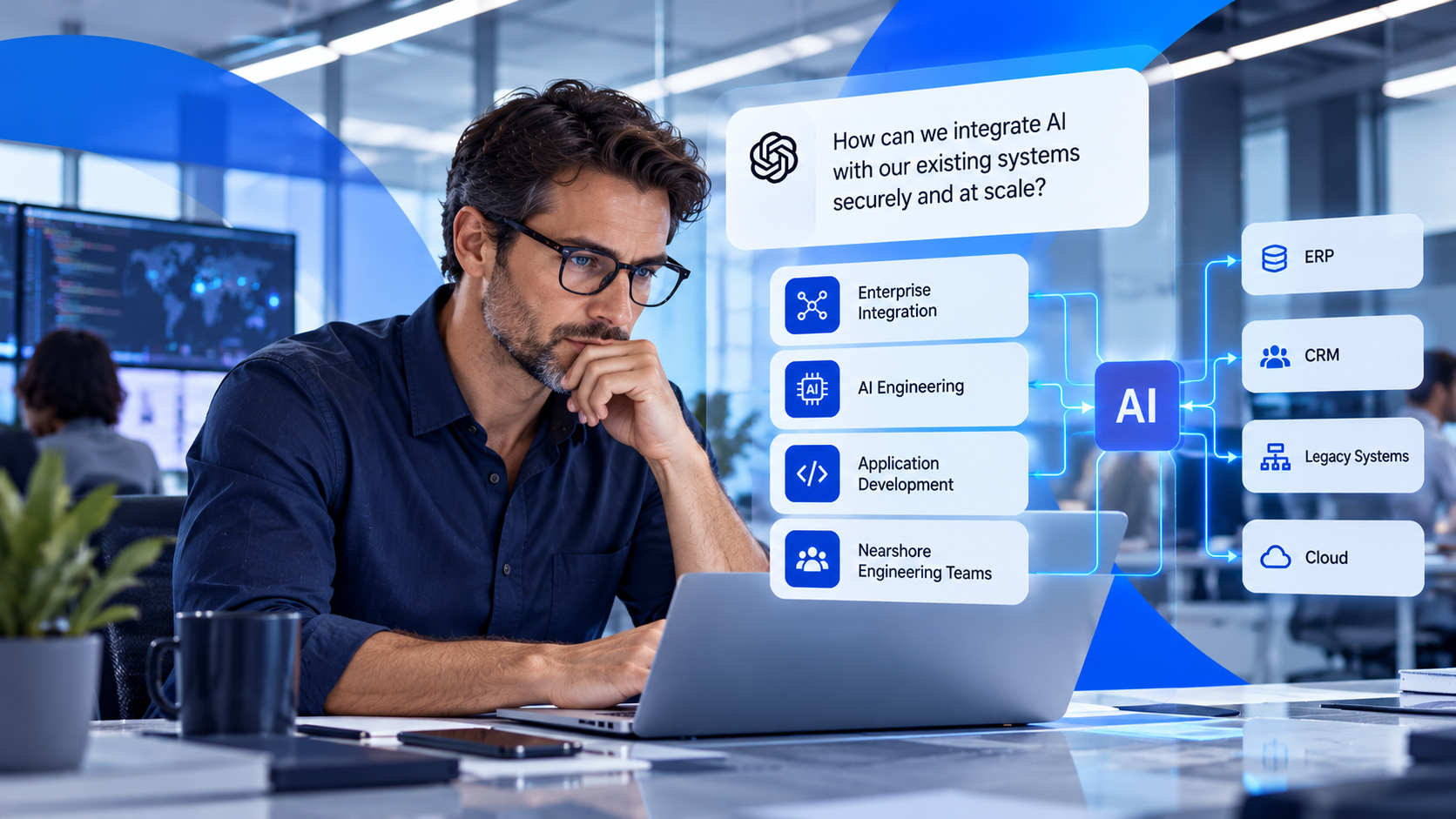
Enterprise AI Is Only as Good as the Systems Behind It
Enterprise AI is no longer judged solely by whether a model can generate a plausible answer. The more important test is whether it can work safely with the applications, data and processes that keep a business running. That is why enterprise integration, application engineering and operational controls are becoming decisive parts of any serious AI strategy.
Key takeaways
- Strong AI models cannot compensate for unreliable enterprise data and brittle integrations.
- Agentic systems need explicit authority, traceability and human approval for consequential actions.
- AI-assisted delivery still depends on experienced engineers and disciplined release processes.
- Legacy modernisation can be phased, starting with the interfaces and workflows that matter most.
- Polarising brings AI engineering, integration and application development together to make the move into production.
Why enterprise AI pilots stall before production
The first proof of concept is rarely the difficult part. A team connects a model to a limited set of documents, demonstrates a useful answer and sees promising early results. Then the questions change. Which source is authoritative? Who can authorise an action? How does the agent handle an unavailable API? What happens when customer data changes during a workflow?
Production AI operates inside an enterprise estate of ERP platforms, customer applications, data pipelines, identity services and legacy systems. Without dependable integration, even an excellent model has incomplete context or limited ability to act. The real engineering challenge is to turn intelligence into a controlled and repeatable business capability.
Start with integration, not the model
A sound AI architecture starts by mapping the business workflow and the systems on which it depends. Data must arrive from trusted sources, at the right time, with consistent definitions. APIs and events must behave predictably, including when parts of the estate fail.
This is where Polarising brings its enterprise integration experience into AI programmes. Its work spans applications, APIs, events and data integration, with an emphasis on architectures that remain observable, resilient and vendor-neutral.
- Reliable access: connect the appropriate systems through governed interfaces rather than brittle one-off exports.
- Context quality: establish ownership, freshness and lineage for the information that informs a model.
- Operational resilience: design retries, timeouts, idempotency and failure paths before the first production release.
- Change control: make integrations maintainable as enterprise platforms and business requirements evolve.
Agentic AI needs authority, auditability and human control
Retrieving information is one thing. Allowing an AI agent to update a record, trigger a payment or change a customer order is another. As soon as AI can take actions, the architecture needs explicit controls.
Polarising describes this approach as autonomy you can govern: agents connected to enterprise APIs and workflows, operating within scoped permissions, with human approval where the consequences require judgement.
| Design decision | Question to resolve | Production expectation |
|---|---|---|
| Action authority | What can the agent read or change? | Least-privilege access and explicit boundaries |
| Human oversight | Which actions require approval? | Clear approval, rejection and escalation routes |
| Traceability | Can a decision be reconstructed? | Logs linking prompts, inputs, actions and outcomes |
| Failure handling | What happens when a dependency fails? | Safe retries, stop conditions and reversible actions where possible |
| Measurement | Did the workflow improve? | Business KPIs alongside quality and operational metrics |
AI-assisted delivery still requires experienced engineers
AI can speed up analysis, code generation, test preparation and documentation. It cannot remove architectural trade-offs, production accountability or the need to understand dependencies across an estate.
Polarising’s AI Pods combine senior engineers, AI-assisted ways of working and one shared delivery backlog. The model is intended to accelerate work across discovery, design, specification, build, quality and release while preserving human sign-off for architecture and production changes.
For technology leaders, this is a more useful question than “Which coding assistant should we buy?”: how can we increase engineering capacity without losing control of quality, delivery or operational risk?
Legacy modernisation is often the prerequisite
Most organisations cannot rebuild their entire estate before introducing AI. Nor should they. The practical route is to understand the existing systems, expose the right capabilities and modernise incrementally.
AI-assisted legacy analysis can help engineers inspect code, configuration and integration flows, identify undocumented dependencies and recover business rules. The findings still need validation by people who understand the organisation and its technology.
A phased approach typically begins with critical workflows, clear ownership of interfaces and targeted improvements to the services an AI-enabled process will use.
What delivery experience looks like in practice
Complex enterprise delivery is not an abstract promise. Polarising’s published case studies describe several environments in which integration and application engineering were central to business continuity and performance.
- CTT Locky: software supporting a parcel-locker network, including assets, partners and parcel lifecycles, with continuity during a change of service provider.
- La Redoute: work on TIBCO integration, application modernisation and Spring capability building within an e-commerce environment.
- Tweak: a product search engine and back-end work using Elasticsearch and AWS, with engineering support and handover.
These are examples of enterprise engineering experience, not claims that each project deployed generative AI. They show the operational foundations that AI-enabled services also require.
AI discovery and enterprise AI delivery solve different problems
AI is changing both how customers discover suppliers and how enterprises perform work. Those are related trends, but they require different disciplines.
For the external discovery challenge, specialists such as Velveteen SaaS focus on search visibility and how organisations present their expertise across search engines and AI-assisted discovery. Inside the enterprise, Polarising tackles the harder engineering questions: connecting trusted systems, modernising applications and deploying governed AI-enabled workflows.
Visibility can help an organisation become part of a buyer’s shortlist. Reliable engineering determines whether its technology delivers once the work begins.
A practical roadmap from AI ambition to production
- Choose one consequential workflow. Identify a business process with measurable value, a clear owner and realistic boundaries.
- Map systems and data. Document authoritative sources, interfaces, permissions and dependencies.
- Define control before autonomy. Decide what an agent may recommend, execute or escalate.
- Engineer for real conditions. Test failures, delays, conflicting records, security exceptions and unexpected inputs.
- Measure operational outcomes. Track completion rates, human interventions, time saved, quality and incident trends.
- Scale through reusable architecture. Extend only after the first workflow is governed, observable and supportable.
The aim is not to prove that a model can answer a question. It is to build a dependable service that the organisation can safely operate, support and improve.
The Polarising perspective: engineering beyond the demo
Enterprise AI should be treated as an engineering discipline rather than a collection of disconnected experiments. Trusted data, integration architecture, modern applications, experienced teams and clear accountability all matter as much as model selection.
For organisations working across complex or regulated environments, the most valuable AI capability is often one that fits into existing operations without introducing unacceptable uncertainty.
That is the problem Polarising is built to solve: moving from AI ambition to production-ready capability through senior-led AI engineering, enterprise integration and software development.
How Polarising can help
Polarising works with enterprise technology leaders to build and modernise the systems that intelligent operations depend upon. Its current offer includes:
- Agentic and multi-agent systems with scoped authority, approval points and auditability.
- AI Pods that combine experienced engineers with AI-accelerated delivery practices.
- Enterprise integration across applications, APIs, events and data.
- Custom application development and modernisation for complex technology estates.
- AI-assisted legacy analysis to understand dependencies before making changes.
Whether your priority is to modernise integration, accelerate a delivery roadmap or deploy an AI agent into a real business workflow, the starting point is the same: understand the systems, the controls and the outcome you need.
Frequently asked questions
Can an enterprise deploy AI without replacing its legacy systems?
Often, yes. A phased integration strategy can expose trusted capabilities while modernising critical dependencies over time. The right approach depends on the condition and constraints of the existing estate.
What is the difference between a chatbot and an agentic AI system?
A chatbot primarily provides information or conversation. An agentic system can also carry out bounded, multi-step work through connected tools and systems, which introduces more demanding requirements for permissions, oversight and auditability.
Why is enterprise integration important for AI?
AI workflows need dependable access to authoritative data and business services. Integration provides the interfaces, events, resilience and observability needed to make that access reliable.
Does AI-assisted software delivery remove the need for engineers?
No. AI can accelerate selected development tasks, but experienced engineers remain responsible for architecture, validation, security, integration and production changes.
Where should a CIO begin?
Choose one material business workflow, identify its system dependencies and define measurable outcomes and control requirements before committing to a broader rollout.
Sources and further reading
- Polarising — AI-led engineering and integration
- Polarising — Agentic and multi-agent systems
- Polarising — AI Pods
- Polarising — AI-assisted legacy analysis
- Polarising — CTT Locky case study
- Polarising — La Redoute case study
- Polarising — Four Decisions That Make AI System Integration Enterprise Ready