

Data quality for AI means your data is accurate, complete, consistent, timely, and fit for the specific model consuming it, measured continuously rather than checked once at ingestion. The single highest-priority action for any team is assigning clear data ownership and measuring agreement continuously, using standards like Krippendorff’s alpha rather than one-time audits. This approach should be integrated into delivery from day one, not as an afterthought.
TL;DR:
- Continuous measurement of data agreement and ownership is essential to prevent failures, especially in unstructured and multimodal AI data.
- Using metrics like Krippendorff’s alpha with a threshold of 0.800 or higher improves annotation reliability, but validation against ground truth remains crucial.
- Building operational controls such as lineage, profiling, anomaly detection, and escalation processes helps manage data quality at an enterprise level.
- Prioritizing fixes based on downstream error cost and occurrence frequency ensures resource focus on the most impactful data issues.
- Employing experienced, governed teams like Polarising accelerates implementation of data quality controls and reduces internal development burden.
Table of Contents
- What Are the Core Data-Quality Dimensions That Break AI Systems?
- How Do You Measure Data Quality With Real Metrics?
- What Makes Annotation and Labeling Actually Reliable?
- How Do You Operationalize Data Quality at Enterprise Scale?
- [What Does an AI data governance framework Actually Require?](#what-does-an-ai-data-governance-frameworkhttpssonanceaicomblogcorporate-it-solutions-a-2026-guide-for-decision-makers-actually-require)
- How Do You Decide What to Fix First?
- Polarising’s Practitioner Perspective and Proof Points
- Why AI Data Quality Is a Different Discipline Than Traditional Data Quality
- What Enterprise Teams Consistently Get Wrong About This
- How Polarising Turns These Controls Into Delivery
- Sources
- FAQ
What Are the Core Data-Quality Dimensions That Break AI Systems?
Traditional data quality checks for six things: accuracy, completeness, consistency, timeliness, fitness for purpose, and representativeness. AI systems amplify the cost of failure in each dimension differently depending on the architecture.
An ML classifier trained on unrepresentative data doesn’t just underperform. It encodes bias that scales across every prediction it makes. A generative model fed inconsistent or stale source documents produces confident, well-written hallucinations instead of visible errors. An agentic system chains decisions, so a single bad data point early in a workflow cascades into a wrong action several steps later, often invisible until the outcome fails. Dataiku’s analysis of data quality across ML, GenAI, and agentic systems identifies poor data quality as the most common reason AI initiatives stall in production.
Run these checklist questions per dimension before any dataset feeds a model:
- Accuracy: Does a sample audit match ground truth, or only match what annotators agreed on?
- Completeness: Are null rates concentrated in specific segments that will bias outcomes?
- Consistency: Do the same entities carry conflicting values across source systems?
- Timeliness: Is the data fresh enough for the decision it informs, or reflecting a stale world?
- Fitness for purpose: Was this data collected for the question the model is now answering?
How Do You Measure Data Quality With Real Metrics?
Profiling metrics come first: null rates by field, distribution shifts against a baseline, and freshness lag between data creation and model consumption. These catch structural problems before they reach annotators or models.
Annotation agreement needs a real statistical baseline, not a gut check. Krippendorff’s alpha handles missing labels better than simpler agreement measures and works across nominal, ordinal, and interval data types.
Target bands that matter: An alpha of 0.800 or higher supports reliable conclusions. Between 0.667 and 0.800, treat findings as tentative and investigate before shipping. Below 0.667, the labels are not trustworthy enough to train on.
Beyond annotation, track these operational signals:
- Rework rate: how often labeled or processed data gets sent back for correction
- Anomaly rate: the frequency of profiling flags per data batch
- Label drift: whether label distributions shift over time without a corresponding data change
- Sample-size caution: small evaluation sets can show high alpha by chance, so pair agreement scores with adequate sample volume
What Makes Annotation and Labeling Actually Reliable?
Treat annotation as a measurement problem, not a data-entry task. Research on annotation quality management found that popular datasets carry 5 to 30 percent label error rates depending on the corpus and task complexity. That is not a rounding error. That is a systemic failure most teams never audit for.
Build the process around four controls:
- Version your guidelines and pilot them first. Run a small batch, measure agreement, revise instructions, and only then scale up. Guidelines that seemed clear on paper routinely fall apart on edge cases.
- Calibrate annotators against each other before full production. A short calibration round exposes systematic disagreements early, when they’re cheap to fix.
- Inject gold and honeypot tasks at 3 to 10 percent of volume. Koji’s annotation quality guide recommends rotating these regularly, because a static gold set gets memorized and stops measuring anything real.
- Route disagreements to adjudication, and record the reviewer’s rationale. For subjective tasks, preserve the label distribution instead of collapsing it to a single majority vote. That distribution is often more informative than the “correct” answer.
Pro Tip: High inter-annotator agreement is not proof of correctness. Annotators can agree consistently while all following a flawed guideline. Validate agreement against a small, independently verified ground-truth sample before trusting it at scale.
How Do You Operationalize Data Quality at Enterprise Scale?
Manual spot checks work for a pilot. They collapse the moment you’re running hundreds of pipelines feeding dozens of models. Observability has to become a system, not a habit.
Three primitives make that system work: lineage tracking that shows where every field originated, continuous profiling that flags distribution changes automatically, and anomaly scoring that ranks issues by severity instead of flooding a dashboard with noise.
Rule-based checks (null thresholds, format validation, range limits) are cheap and catch known failure patterns. They miss the failures nobody anticipated. ML-driven anomaly detection surfaces distribution shifts and cross-field dependencies that static rules never catch, because it learns what “normal” looks like instead of checking against a fixed rule. Use rules for the failures you already know about; use ML detection for the ones you don’t.
Agentic monitoring extends this further with adaptive thresholds that adjust as your data evolves, automated triage that routes issues by severity, and runbooks that specify exactly who gets paged when a threshold breaks.
- Lineage answers “where did this come from”
- Profiling answers “what does this look like right now”
- Anomaly scoring answers “is this normal”
- Agentic triage answers “who needs to act, and how fast”
Pro Tip: Don’t let agentic monitoring run without an escalation path. An automated system that detects a problem but has nowhere to send the alert is just a more expensive way of ignoring it.
What Does an AI data governance framework Actually Require?
Governance for AI is not a policy document. It’s an operational system with five pillars, and STRAC’s framework for AI data governance lays them out clearly: discovery and classification, access control and redaction, monitoring and audit, vendor lifecycle management, and retention and decommissioning.
Each pillar maps to a concrete responsibility:
- Discovery and classification: know what data exists and how sensitive it is before it ever touches a model
- Access and redaction: control who and what (including third-party LLMs) can see sensitive fields
- Monitoring and audit: log every access and transformation so you can reconstruct what happened
- Vendor lifecycle: track every external model or data provider against contractual and security terms
- Retention and decommissioning: delete data on schedule instead of letting it accumulate as liability
A defensible audit trail combines lineage records, access logs, and ticketed ownership. When a regulator or internal auditor asks “who approved this dataset for production,” you need a name, a ticket, and a timestamp. Governance frameworks that integrate with AI lifecycle controls also produce the evidence needed for standards like SOC 2, ISO, and the NIST AI RMF, which auditors increasingly expect by name.
How Do You Decide What to Fix First?
Not every data-quality alert deserves the same response. Triage by two variables: how costly the downstream error is, and how often it occurs.
- High cost, high frequency: block deployment and fix immediately. This is the combination that produces headline-level failures.
- High cost, low frequency: relabel the affected segment and add a targeted monitoring rule.
- Low cost, high frequency: retrain on the next cycle rather than pulling an emergency fix.
- Low cost, low frequency: log it and move on.
Track three KPIs to keep this honest: time-to-fix from detection to resolution, downstream error cost per incident, and incidence rate per million predictions. Teams that track these three numbers consistently catch degradation weeks before users notice it.
Polarising’s Practitioner Perspective and Proof Points
Polarising builds ownership, monitoring, and audit trails directly into delivery through its AI Pods model: senior nearshore teams from the UK and Portugal who treat data quality as a deployment gate, not a post-launch cleanup task. In the TAP Air Portugal integration revamp and the CTT Locky platform transition, the pattern held: define ownership and monitoring thresholds before code ships, not after.
The engagement model that works best runs pilot to production to runbook handover, so the client’s own team inherits a system they can operate, not a black box they have to reverse-engineer.
Why AI Data Quality Is a Different Discipline Than Traditional Data Quality
Traditional data quality asks whether a database is clean enough for a report or a dashboard. AI data quality asks whether a dataset is clean enough for a model that will make autonomous decisions at scale, often without a human reviewing each output.
That distinction changes everything about how errors propagate. A wrong number in a quarterly report gets caught by an analyst who knows the business. A wrong label in a training set gets baked into millions of predictions before anyone notices, because the model doesn’t know it’s wrong, and it applies the error with total consistency. That consistency is the trap: a biased or mislabeled pattern doesn’t show up as noise, it shows up as confident, systematic behavior that looks like the model working correctly.

Generative and agentic systems raise the stakes further. A large language model trained or grounded on inconsistent source documents doesn’t fail visibly. It produces fluent, plausible answers that happen to be wrong, a failure mode traditional data quality tooling was never built to catch because it assumes structured, tabular data with clear validation rules. Unstructured and multimodal inputs (documents, images, audio transcripts) don’t fit those rules at all, which is why modern data quality programs need profiling and anomaly detection built for unstructured content, not just schema checks.
Synthetic data adds another layer. It can fill gaps in underrepresented segments and reduce labeling cost, but only when it’s validated against real-world distributions and flagged with provenance so downstream monitoring can catch drift introduced by the synthetic samples themselves. Treat synthetic records as a supplement to measured, governed real data, not a substitute for it.
What Enterprise Teams Consistently Get Wrong About This
Most organizations still treat data quality as a cleanup phase: something you do before training and forget about after deployment. That framing is backward. The research on annotation quality makes this explicit. Popular, widely used datasets carry meaningful label error rates precisely because teams check quality once and assume it holds. It doesn’t. Data drifts, guidelines age, and new edge cases appear the moment your model touches real-world traffic.
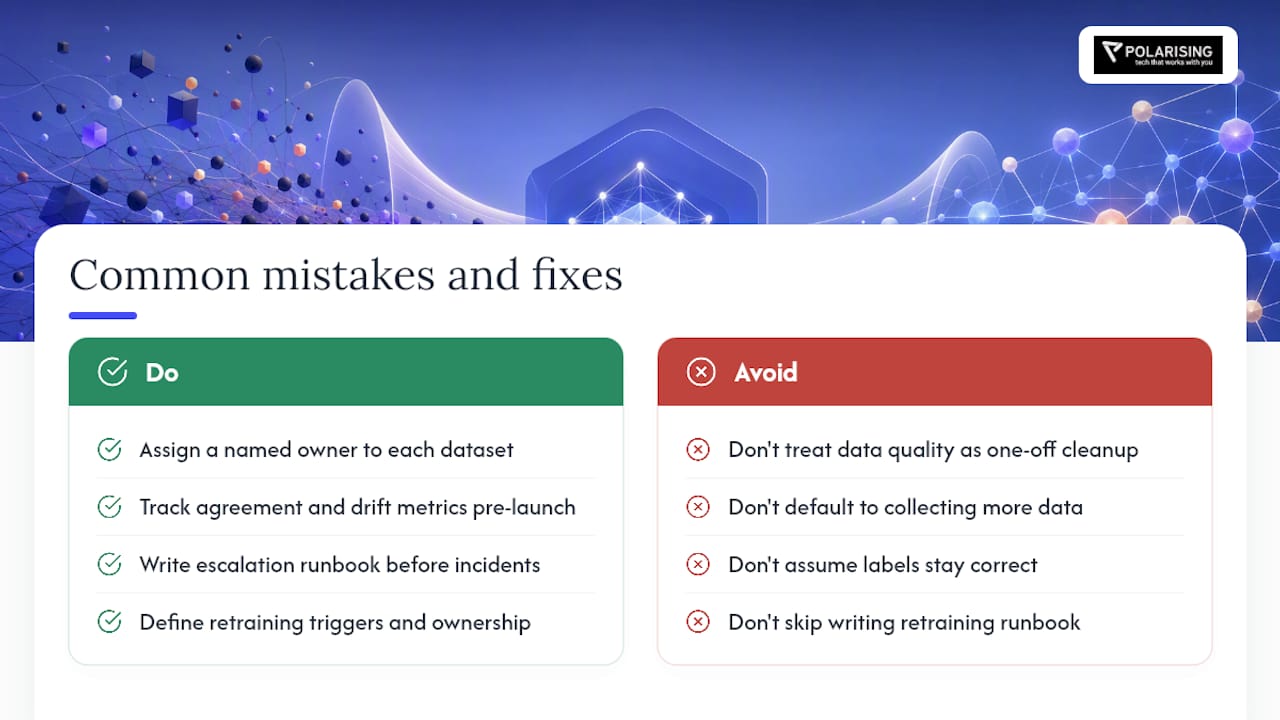
The overrated fix is more data. Teams facing a quality problem often default to collecting more of it, when the actual gap is measurement discipline: nobody is tracking Krippendorff’s alpha per label, nobody owns the retraining trigger, and nobody has a runbook for what happens when drift crosses a threshold. Volume doesn’t fix a measurement gap. It just makes the eventual audit more expensive.
What should come first is unglamorous: assign a named owner to every dataset feeding a production model, instrument agreement and drift metrics before launch, and write the escalation runbook before you need it, not after an incident. This operationalization is helpful for enterprises that need support from experienced teams rather than re-inventing processes internally under deadline pressure.
— Polarising Team
How Polarising Turns These Controls Into Delivery
One alternative to hiring and training an internal data quality function from scratch is to engage senior nearshore teams who arrive with governance, monitoring, and annotation controls already built into delivery rather than added after production incidents.

This approach allows organizations to spend less time assembling a data governance program in-house and more time running one that has proven effective in regulated environments across sectors like finance, healthcare, and telecommunications. Polarising’s AI engineering services cover the full path from pilot to production, with audit trails, ownership assignments, and drift monitoring built into the handover, not left for your team to figure out afterward. For teams that need dedicated capacity rather than a one-off project, the AI Pods model provides a standing delivery team that scales up or down as the work demands.
If your organisation is planning a pilot that needs to survive contact with production data, start by requesting a scoped assessment through Polarising’s AI engineering page.
Sources
- Voxel51 — Inter-annotator agreement glossary
- Analyzing Dataset Annotation Quality Management in the Wild (arXiv)
- AI Data Governance: Framework, Best Practices & How to Implement It (STRAC)
- Data Quality Monitoring at scale with Agentic AI (Databricks blog)
- Data Annotation Quality: Guidelines, Agreement Metrics, and Gold Tasks That Actually Work (Koji)
FAQ
What is the 30% rule in AI?
The figure that does show up in research is that popular datasets can carry 5 to 30 percent label error rates depending on the corpus, which is why annotation needs to be treated as an ongoing measurement problem rather than a one-time task.
What are the five points of data quality?
The core dimensions are accuracy, completeness, consistency, timeliness, and fitness for purpose, with representativeness often added as a sixth for AI-specific use cases where biased sampling directly produces biased model behaviour.
Why does data quality matter for AI?
Poor data quality is one of the most common reasons AI initiatives fail in production, because errors that a human analyst would catch in a report get applied by a model with total, invisible consistency across every prediction it makes.
What are the six pillars of data quality?
Definitions vary across organizations, but a common version combines the five core dimensions (accuracy, completeness, consistency, timeliness, fitness for purpose) with representativeness, while governance frameworks like STRAC’s model define a separate five pillars for AI data governance specifically: discovery, access control, monitoring, vendor lifecycle, and retention.
How is data quality different for generative and agentic AI?
Generative models fed inconsistent data produce fluent, confident wrong answers instead of visible errors, and agentic systems chain decisions so one bad data point can cascade into a wrong action several steps downstream, a failure mode traditional data quality tools weren’t built to catch.